• Thank you for visiting HeavyEquipmentForums.com! Our objective is to provide industry professionals a place to gather to exchange questions, answers and ideas. We welcome you to register using the "Register" icon at the top of the page. We'd appreciate any help you can offer in spreading the word of our new site. The more members that join, the bigger resource for all to enjoy. Thank you!

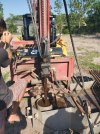
My long quest for water... A homemade well drilling rig. Have you ever done this?

Tony Wells

Senior Member
Joined
Jul 18, 2019
Messages
806
Location
Tyler, TX
Occupation
HogZilla Keeper
Oilfield does it with slips to keep you from losing the string downhole and a pair of tongs that make and break the connection. Not sure you'd benefit from spinning chains, but maybe.

And I'd say you'd benefit from some thrust bearing setup. The entire string weight will be on the BHA and will be hard to guage, so the torque on the bit be guessing.
 

Georgia Iron

Senior Member
Joined
May 6, 2012
Messages
1,319
Location
USA - Georgia
Occupation
Concrete building slab and grading contractor
Thanks Tony, do you have any pictures of slips and tongs?

I did a Google search on the tongs. It pulled up some impressive gear. Out of my price range. Maybe i could come up with a simpler design.
 
Last edited:

Tony Wells

Senior Member
Joined
Jul 18, 2019
Messages
806
Location
Tyler, TX
Occupation
HogZilla Keeper
There are a few versions of slips, so you could adapt the concept to fit your application. Here's a couple of references:


Tongs:


Keep in mind those are considerably larger and thus heavier that you probably need. The idea and how they work you could use. Those tongs are suspended from above, and wrap around the pipe or collar....tool, whatever, and are pulled in whatever direction needed to tighten or loosen the connection. They are used in pairs. One is anchored to the structure, the other is pulled by drawworks but could be powered by a cylinder. I would think though, that you could combine a slip function, which normally is just tossed around the string and is tapered on the outside so that when the string weight is let down, there is a mating socket that pinches it around the pipe. If that were properly fixed to not rotate, that would sub for one tong. Once you are reconnected, just raise the string and the taper releases. Pull the slips out of the socket and toss aside until needed again.

Another idea to borrow might be from the sucker rod used in a well. The connections actually have wrench flats and are made/broken by good strong hands. Pipe like you have would be tighter so probably too much by hand, but borrow the idea of wrench flats and get away from tongs and pipe wrenches.
 

DMiller

Senior Member
Joined
Feb 21, 2010
Messages
19,244
Location
Hermann, Missouri
Occupation
Cheap "old" Geezer
Slips are similar to the Clamps used to squeeze Hose Fitting, Tapered Collet into a Tapered Hole. The Wrenches are far and above some MEAN Hardware as to grip yet release easily. Also No TEEFs Damage as with a Pipe Wrench.

Drill Rig Boys are a Breed all to their own!!!

As to Auger Drive, Set it up on a Hex Drive, all the HP on the Hyd Motor will destroy Boxcar Loads of Shear pins, No Need with the Hydraulics to Drag it back out of the Hole as needed, as well have Reverse do not have on a PTO.
 

John C.

Senior Member
Joined
Jun 11, 2007
Messages
13,135
Location
Northwest
Occupation
Machinery & Equipment Appraiser
I'm confused because all the drill steels in that size range that i've worked with had a flattened section next to the threads where a wrench would fit onto and lock on the steel. We also had problems with the steels locking in the collars when the ends of the steels were not ground square, and the bevels on the ends were not truly round or the threads on the steels were worn out. Changing steels was only done on the bottom of the mast. We did at times have problems where the drill steel unscrewed out of the driver with the drive up in the air. Then you climbed the mast and hauled up a big pipe wrench with a rope and moved things back line and screwed the steel back into the upper collar. We also had collars explode when using steels with worn out threads. I did have to take care of a blast hole drill at one time with eight inch steels and running trio-cone and drag bits. Those really suck when the steels get stuck on the collars but the drill had provision for it.
 

02SILVER

Well-Known Member
Joined
Apr 5, 2011
Messages
79
Location
Florida
These guys let me look at their rig two summers ago. Might have something here worth gleaming. Looks like they modified the rod to have ears that get captured by a folding gate. I do not know how they held the string on the trip out. They said they go 200' on some wells. Very nice aluminum mud recycling pan. Disregard the lack of steel toes, this is in a coastal region lol
20240712_090305.jpg20240712_090314.jpg
 

Georgia Iron

Senior Member
Joined
May 6, 2012
Messages
1,319
Location
USA - Georgia
Occupation
Concrete building slab and grading contractor
I'm confused because all the drill steels in that size range that i've worked with had a flattened section next to the threads where a wrench would fit onto and lock on the steel. We also had problems with the steels locking in the collars when the ends of the steels were not ground square, and the bevels on the ends were not truly round or the threads on the steels were worn out. Changing steels was only done on the bottom of the mast. We did at times have problems where the drill steel unscrewed out of the driver with the drive up in the air. Then you climbed the mast and hauled up a big pipe wrench with a rope and moved things back line and screwed the steel back into the upper collar. We also had collars explode when using steels with worn out threads. I did have to take care of a blast hole drill at one time with eight inch steels and running trio-cone and drag bits. Those really suck when the steels get stuck on the collars but the drill had provision for it.

I repurposed some used ditch witch type horizontal drill stem. It has had a lot of prior use. The pipe is 1.75 inches except on each end where it was spilt and the female and male ends were welded in. I did see some stems like you were talking about.

I have been studying water well drilling for a while now. I have seen people weld on some square bar on each female end, one small piece each side so that the hanging rod will lock into a notch on the barn door table. this allows you to break the connection with the auger motor and add another piece of drill rod.

I came up with wrench idea watching a commercial water well drill rig on youtube. They cut the handle short on their wrench, and they used it at the bottom to break the top connection loose on their 20' drill stems. The half wrench was mounted to a cylinder.

The professional rigs also have a swinging revolver barrel that sits off to the side that holds 6 or 8 pipes vertically. A hydraulic cylinder swings the unit in and out to add and remove pipe. And finally, I saw a center cylinder on the table which would push/pinch and hold the drill stem to allow the wrench to work. I am using a table instead of another cylinder. I really dont have room to add it.

The wrench works well under my testing. You can use the hydraulics to loosen or tighten the wrench as needed and it is almost weightless to swing into position.

I spent another day building supports that will lock the bottom of the mast to the frame of the machine. The mast supports use a left and right hand threaded end and you can spin the center section to loosen or tighten the bars. I also built a 2nd set of barn doors that will be setup just for my casing size.

This brings me to my final 2 items. I need to clean up the hydraulic hoses and I am thinking that I will cut the drill stem apart near the motor and go ahead and add a "thrust support of some type".

Then I will being testing and building the air lift mud pump assembly and on then on to drilling my well.

I also called and inquired about a down the hole hammer. I dont see that working out. The expense is a lot and my pipe will not carry enough air, most use a 2.5" pipe or bigger and 500 cfm. If I hit hard rock more than likely I am going to not make it threw it. I could try to use a cable and drop a heavy rod over and over in the same place. Hoping for no rock.
 
Last edited:

Georgia Iron

Senior Member
Joined
May 6, 2012
Messages
1,319
Location
USA - Georgia
Occupation
Concrete building slab and grading contractor
These guys let me look at their rig two summers ago. Might have something here worth gleaming. Looks like they modified the rod to have ears that get captured by a folding gate. I do not know how they held the string on the trip out. They said they go 200' on some wells. Very nice aluminum mud recycling pan. Disregard the lack of steel toes, this is in a coastal region lol
View attachment 359996View attachment 359997

That is a nice mud pan. Thanks for sharing. Those ends are what I was talking about above.
 

Georgia Iron

Senior Member
Joined
May 6, 2012
Messages
1,319
Location
USA - Georgia
Occupation
Concrete building slab and grading contractor
So i decided to mount the drill motor. I want to see if it has enough hydraulic power to actually drill a hole.

In order to do this I needed to build a coupler and slice a drill rod in half to make connections to my auger bit.

So I come up with some more junk laying around and weld it up.. I finally have a auger hanging off the motor. I did not build a bearing assembly that would prevent pressure from pushing up on the gear reduction from the bottom. I am up in the air on that and that will take at least 2 days to figure out.

View attachment 359865

My test hole went OK. I need to change up a few hydraulic lever controls. I need it to turn and move down and the same time.

The motor spins slow. As in about a 1/3 speed of what i would prefer. The machine has enough down pressure to pick the whole front end up in air. The motor does not stop spinning so the gear reduction must be a lot.


So it passes the "will it dig test" but I ran into several problems. The first problem is it pretzeled the 5/8 shear pin i put in the coupler. I was thinking it could shear if it bound up. It is not even close to strong enough. I switch that out to a hardened 7/8s bolt. To do this I had to take everything apart and redrill the holes with the mill.

The next issue i ran into is the tapered drill rods locked together so tight it took Me 2 hours to get them back apart. A 4' pipe wrench and 1000 lbs table and vice was not enough. I had to lock it down in the back of a forklift counter weight and use an excavator to push on the wrench.


I quickly came to realize that unscrewing the drill rods is a problem that I cant handle without some mechanical advantage.

I have been unsure of how to accomplish this task. Because there are 3 factors that need to be addressed. The lower drill rod needs to be held in place and supported so that it can not fall into the hole, it also needs to be locked down so that it does not spin. The middle drill rod needs to be unscrewed at the top side which will be 10' in the air and it needs to unscrew from the lower drill rod.

After much thought I decided to build a barn door style table that could clamp and hold the lower rod.

View attachment 359866

Then I decided to put hydraulics on a pipe wrench to be able to break the upper connection.

View attachment 359868

If your paying attention you will notice the wrench is up sidedown that tightens the connections...

The problem I have now is the drill stem connection which is 10' up in the air. Depending on which joint is the tightest, using the drill motor to unscrew the connections, the weaker connection will let go first. This could be the one at the motor or the connection at the table. If it lets go at the motor first I must unscrew the rod by hand which pisses me off because I wanted to use the motor hydraulics.


I have not worked through this issue yet.

I also need to figure out how to clean up the hoses. The machine has 20 different hydraulic functions so hoses are everywhere.

Left out rigger up / down
Right out rigger up/ down
Hydraulic winch in/ out
Mast tilt up /down
Motor up / down
Drill direction left/ right
Hydraulic wrench in /out
Push blade up / down
Push blade tilt left /right
Push blade angle left / right

View attachment 359867
Last picture is some photos of some different pipe hold ideas i was looking at.

I made an error in my math here.

The machine also has hydraulic steering on both the front and rear axle.

This is done with a hydrulic steering gear.

For a total of 24 different hydraulic functions.
 

Tony Wells

Senior Member
Joined
Jul 18, 2019
Messages
806
Location
Tyler, TX
Occupation
HogZilla Keeper
What is the hole size? Just so happens I have (in the past) developed various hammers that are meant to be used in coil tubing work. I have some left over prototypes that you might be able to use. Likely have to make up some adapter subs to thread it all together, but they may be useful to you. They will drill rock. Carbide inserts, buttons, or a nickel/carbide matrix. They are meant to run on either nitrogen or air. How much air you have available?
 

Georgia Iron

Senior Member
Joined
May 6, 2012
Messages
1,319
Location
USA - Georgia
Occupation
Concrete building slab and grading contractor
What is the hole size? Just so happens I have (in the past) developed various hammers that are meant to be used in coil tubing work. I have some left over prototypes that you might be able to use. Likely have to make up some adapter subs to thread it all together, but they may be useful to you. They will drill rock. Carbide inserts, buttons, or a nickel/carbide matrix. They are meant to run on either nitrogen or air. How much air you have available?
I am planning on a 9" hole. I have a 6 cylinder diesel that produces 500 cfm. I am not sure of the cfm i would have. According to chat using a 1" pipe it would have 100 cfm to 150 cfm. The drill stem hole might be 1 1/4. According to local drill reports I will hit sandstone at 63' for approximately 6 to 8' thickness.

The local guy I went and visited had a rack full of worn out hardened heads that had carbide inserts welded to cutting heads. He stated they used to grind through the sandstone in the past, said the process was slow. Now with there newer drilling equipment they hammer through.
 

John C.

Senior Member
Joined
Jun 11, 2007
Messages
13,135
Location
Northwest
Occupation
Machinery & Equipment Appraiser
I worked at a coal mine where the blast hole drill was. We were drilling eight inch holes forty to eighty feet deep and started using try-cone bits that cost around $2,800 each. That wasn't cost effective as the bit was only good 50 to 100 holes and then it had to be replaced. The holes started in glacial till and hit white sandstone. We changed to the drag bits as the carrier cost about $500 as I recall and the inserts were less that $100 apiece. As I recall we were getting up to 15,000 foot of holes on one carrier. That was cost effective at that time. Later on we excavated the till with dozers and loaders and then just drilled the sandstone. The drag bits were great when working in solid rock. The drill worked on down force and rotation. We didn't have a drifter for it and didn't need one for the material we were working in.
 

Tony Wells

Senior Member
Joined
Jul 18, 2019
Messages
806
Location
Tyler, TX
Occupation
HogZilla Keeper
The largest hammer I built was 4 1/2", so my motors and bits may be no use to you. The general idea was to stay small then scale up. It never went up to your size. It started with 2 1/8" hole size. There is a lot of smaller work and a great demand for the smaller rotary motors and bits in remedial work and simple paraffin cleanouts in gas wells. I did turbine driven rotary motors and reciprocating hammers for drilling, and a few wild variations that didn't prove out. I have done just the bit work for SII and RBI on bits up to 36", but I'm not equipped these days for that, nor do I own those designs.
 

Georgia Iron

Senior Member
Joined
May 6, 2012
Messages
1,319
Location
USA - Georgia
Occupation
Concrete building slab and grading contractor
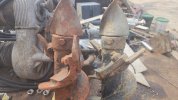
Here is the type of soil I will be boring in.

upper soil type.jpg

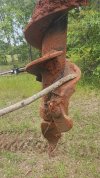
As it sits in the heat and dry's it turns almost into a brick. I was testing my auger out and I did this.

bent auger teeth.jpg

I have 2 of the same augers. 9". The one on the right is about the right factory angle to cut. The one on the left you can see the 1/2" steel bent and the teeth will not cut. I brought the bit back to the shop to compare it to the other one. I used a torch and heated the steel and got it close to being bent back out.

I am not 100% sure that I did this to the bit or if someone that I let borrow the skid steer did it. It was caked in dirt and I did not bother to clean the cutting edges off. I just noticed that I was having a hard time drilling a hole.

I was surprised to see the teeth bent back like this . I have never experienced this before.

2nd angle.jpg
 

DMiller

Senior Member
Joined
Feb 21, 2010
Messages
19,244
Location
Hermann, Missouri
Occupation
Cheap "old" Geezer
Only tome saw that on my 3 pt auger was on a Buried stump, took a lot to get it unwound off that.
 

Welder Dave

Senior Member
Joined
Oct 11, 2014
Messages
17,950
Location
Canada
There had to be a lot of pressure to bend those bits back like that. Big rock maybe? When I drilled post holes and hit roots or old stumps it just stopped the auger. Maybe you could weld a T like brace on the back to strengthen the tips.
 

Georgia Iron

Senior Member
Joined
May 6, 2012
Messages
1,319
Location
USA - Georgia
Occupation
Concrete building slab and grading contractor
I decided to go ahead and add a drill rod thrust support. I am going to use a sealed front wheel bearing from a f250 4 x 4. According to what I have found online they can handle both radial and axial loads in excess of 10,000 lbs.

In order to install this bearing assembly I needed to tightin up my tolerances. So I began by removing the drill rod attachment I made and starting over on assembly.

The main issue i have had is attaching the drill rod to the drive gear with out using heat and ruining the seals.

I came up with a clamp type system that is bolted to the gear. The wheel bearing will be used in between the clamp and the drill rod. It will be permanently mounted to the drill motor metal support carrier.

I attempted several different variations including using an old f250 steel wheel as a mounting bracket.

20260516_151513.jpg

Wasted a fair amount of time building junk into more junk.

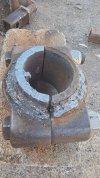
The pieces of my clamp was worn out and uneven, it came from an 850 john deere dozer blade that was very well used.


20260517_094704.jpg
I first cut it fairly close to length with a plasma cutter and hand grinder. Then I decided to set it up in the lathe and cut it straight.

This was a fairly scary thing to do. It is not a balanced part and the lathe was jumping off the concrete floor.

Probably would have got an F in machine shop class for this.

The clamp weighs about 30 lbs.

20260517_095534.jpg
 
Last edited:
Top