• Thank you for visiting HeavyEquipmentForums.com! Our objective is to provide industry professionals a place to gather to exchange questions, answers and ideas. We welcome you to register using the "Register" icon at the top of the page. We'd appreciate any help you can offer in spreading the word of our new site. The more members that join, the bigger resource for all to enjoy. Thank you!

The Engineering, Design and Building of a Timber Trestle

GunnieSacked

Senior Member
Joined
Oct 27, 2024
Messages
469
Location
Nanaimo
Thats a good read on the Culliton Brothers. I live near some of thier past work on the E&N Railway.
Glad that you found the article on Culliton Brothers interesting.
It’s nice to have some insight into the workers who were behind the building of the trestles. The engineering behind the design of the trestles is amazing but the building of the trestles, where they were built and by the workers, was astonishing.
 

GunnieSacked

Senior Member
Joined
Oct 27, 2024
Messages
469
Location
Nanaimo
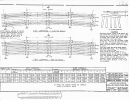
CPR Layout for Curved Track

IMG_3374.jpeg


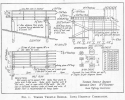
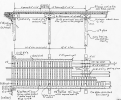
Common Standard Double Track Ballasted Deck Trestle

IMG_3455.jpeg

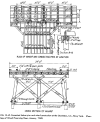
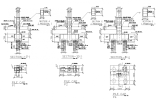
Pile Cap Connection

IMG_3426.png

Splices for Butted Piles

IMG_3435.jpeg


The link below is a
complete analysis of all aspects of building a Railroad. Surveys, structural analysis, wood types and length of longevity, rail components and everything else you could consider to complete it. If you are into Engineer, you will find this a vault of information.

RAILROAD CONSTRUCTION
THEORY AND PRACTICE
 

Bootheal

Senior Member
Joined
Apr 26, 2015
Messages
403
Location
Jackson, MO
Sorry for being so challenged finding stuff. There was another word used in days past to describe this and it wasn’t ‘challenged’.

There was a link to something like a pocket reference manual for building RR trestles, laying out routes, surveying…anyone know what I’m talking about or did I just make it up?

Rusty brown pages. Late 1800’s to early 1900’s.

I was amazed at the trestle pictures. Thanks for sharing.
 

Bootheal

Senior Member
Joined
Apr 26, 2015
Messages
403
Location
Jackson, MO
Again my apologies. The one raised by the village found what he was looking for. Apparently the page didn’t load or didn’t load properly as now, it’s in plain sight.
 

GunnieSacked

Senior Member
Joined
Oct 27, 2024
Messages
469
Location
Nanaimo
IMG_3344.jpeg

Seems I forgot to add this side note to the Railroad Construction link;
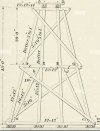
explaining the trestle designs heights and other specifications.

see "Railroad Construction, Theory and Practice" by W.L. Webb.

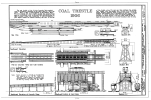
For most trestles less than 30' tall, the bent spacing varies from 10' - 16'. Each railroad had it’s own specs that they chose based on many factors, such as weight load on the line, local lumber species available, and the cost of construction. The N&W for example specified 12'6" centers on their bents.

The stringers were based on the weight load and span between bents.

The PRR for example specified Yellow Pine stringers under each rail for locomotives less than 200,000 lbs. of:
Two 10"x16" for a 10' span
Three 8"x16" for a 12' span
Three 10"x16" for a 14' span

For locomotives of over 200,000 lbs.
Two 10"x16" for a 10' span
Three 10"x16" for a 12' span
Steel stringers for 14' span

Simple answer. The trestle bent spacing is dictated by the length of the stringers. These are the big timbers that the ties sit on. The stringers are grouped in sets of three or four centred under each rail. The stringers are usually 32 feet long. The joints for the stringers are staggered to ensure that not all of the stringer ends line up.
The stringer then has a trestle bent support at each end and one in the centre.
This means that the trestle bents are at 16 foot centres or 1.2 inches in N scale.
The one obvioius question is why are the stringers 32 feet long?
Very simple, most saw mills had saw benches with 32 foot maximum travel.
Made this discovery many years back when building my HOn3 Rio Grande southern layout.
 

Oxbow

Senior Member
Joined
Nov 22, 2012
Messages
1,792
Location
Idaho
If anyone remembers the Charles Bronson film entitled Breakheart Pass, there is a trestle in the film that can be seen on Hwy. 95 in Idaho near Culdesac. I believe it is still standing.
 

GunnieSacked

Senior Member
Joined
Oct 27, 2024
Messages
469
Location
Nanaimo
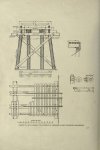
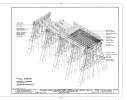
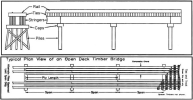
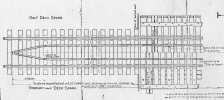
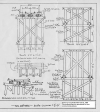
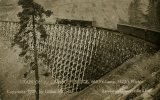
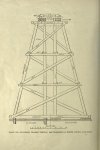
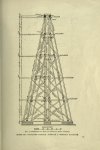
A Treatise on Wooden Trestle Bridges and Their Concrete Substitutes According to the Present Practice on American Railroads

Abstract​

IN the present edition of this work, which was first published in 1891, will be found a very full account of the construction, erection, maintenance, and preservation of timber trestle bridges. The book is profusely illustrated, and contains working drawings showing the details of the standard trestles used on the principal American railroads. Wooden trestles may be disappearing gradually from main lines of heavy traffic, but the increased growth of branch lines, or feeders, and of trestles at manufacturing plants and for electric railways, have probably more than kept pace with its abandonment on main lines. There is. on the average, about 100 ft. of bridges and trestles to each mile of railroad in the United States. The wearing out of wooden trestles and the increasing cost and scarcity of timber suitable for their replacement has taxed the ingenuity of railroad officials to find suitable structures to take their place. In some cases iron or steel structures have been employed, but there are numerous districts where local conditions make these methods so expensive as to be prohibitive.
A Treatise on Wooden Trestle Bridges and their Concrete Substitutes.
By Wolcott C. Foster. Fourth revised and enlarged edition.

IMG_3839.jpeg

IMG_3840.jpeg

IMG_3841.jpeg

IMG_3842.jpeg
 
Last edited:

GunnieSacked

Senior Member
Joined
Oct 27, 2024
Messages
469
Location
Nanaimo
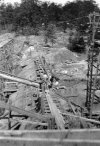
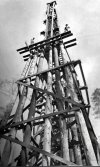
The Trestle Builders
A tribute to all the people involved, in the complete build, from the surveying of the R/W to the building of the grade and the construction of the Trestles.
With their fortitude to overcome where they had to work, what they had to work with, how they had to supply their materials to the sites they were able to erect these magnificent structures!

IMG_3992.jpeg
The beginning of the Trestle

IMG_3993.jpeg
Almost Completed Trestle

IMG_3994.jpeg
Finished Trestle

IMG_3995.jpeg
Mother Nature
 
Top