• Thank you for visiting HeavyEquipmentForums.com! Our objective is to provide industry professionals a place to gather to exchange questions, answers and ideas. We welcome you to register using the "Register" icon at the top of the page. We'd appreciate any help you can offer in spreading the word of our new site. The more members that join, the bigger resource for all to enjoy. Thank you!

Spicing wires and plugs

Mallard

Active Member
Joined
Oct 4, 2016
Messages
34
Location
Arkansas
My JD 200CLC is throwing codes 15 and 16 which are arm in and boom up. I finally found their locations in the manual and checked them today and one arm in wire is cut about 18 inches back from the plug. The boom up had two cut wires, both as they entered the main harness, and one is also cut about 1/4” out of the plug.

What is the best way to fix these, I’ve never messed with anything smaller than 18ga. I have some crimp connections that you just twist them together then insert and crimp. I think this will work fine for everything but the one right at the plug.

Can these plugs be disassembled and just insert a new wire? If so what is the best way to get it apart? I can cut the last remaining wire which will leave me a pig tail I can work on at the bench.
 

Christeon

Member
Joined
Apr 17, 2026
Messages
6
Location
Alabama
Occupation
Toolmaker
I prefer open barrel crimps. You get a good crimp on the wire and a separate crimp on the wire and insulation that way. The pins inside the harness are usually crimped the same way. You would need the correct crimping tool and the terminals.

On the 1/4" you could slip on shrink tubing on wire, solder, then slip the shrink tubing as far as possible into the terminal.

splice1.jpgsplice2.jpg
 

Joe H

Senior Member
Joined
Nov 28, 2023
Messages
896
Location
Utah
All kinds of repair kits for terminals, and there are hundred of different terminals.

I know you need just one, but one isn't easy to come by.


This will get just about any of them apart


Mallard

Active Member
Joined
Oct 4, 2016
Messages
34
Location
Arkansas
Thanks for all of the help, I’ll go back tomorrow and get a better look and clean under there better.
Regarding why the wires are cut, not sure, this machine was an auction purchase so I’m going through fixing everything back as close to 100% as possible. After this I think I just have a couple small hydraulic leaks to track down and I’ll be ready to test it out more and see if anything pops up. To date the longest I’ve used it actually working is one hour digging. That’s after pressure washing for a few hours and I found more leaks.

I’ll order the connector removal tool tomorrow after I get a better look at the plug.

Thanks again
 

LCA078

Senior Member
Joined
Sep 29, 2019
Messages
718
Location
Austin, TX
For these kind of wires (similar to trailer light wires and such), in my opinion it's not so much how you connect them together, it's how you seal them afterwards to keep the moisture out (to prevent corrosion). I agree with soldering and covering with heat shrink but definitely use a heat shrink with adhesion or glue already in it. Or, connect it and cover the splice in liquid electrical tape then heat shrink on top while the liquid tape is still wet to squish the liquid tape and form a water tight seal.

There are even heat shrinks with a solder ring inside that melts and forms the connection when you shrink it. Just overlay the wires, maybe with a slight twist, and apply heat. I've used these with lots of trailer lights and they do a decent job of making it easy, especially in areas where you don't have a lot of room for crimpers, hands, etc. Just practice on a couple pieces of spare wire to make sure you figure out how to apply the right amount of heat, etc. https://powerwerx.com/heat-shrink-s...Andp3wMn_YMZvDXQrwnKx3NU7EEp50PBoC1JsQAvD_BwE You can find lots of these on amazon too.

For the one that is 1/4" cut from the connect, a crimp butt splice like Christeon followed by heat shrink with adhesive will get you going. I personally don't like pulling/replacing pins if I can avoid it.

Ohh- and don't be afraid to splice in a few inches (or even a foot) of wire, especially for the one that is 1/4" away from the connector. Just tape or wire-tie the excess back on the loom when done. It's so much easier to work a good connection when you have play in the wires.

Lastly, if you're in it, I recommend applying dielectric grease to the connectors to keep the seals watertight and pins free of corrosion. Will make disconnections in the future so much easier....
 

HarleyHappy

Senior Member
Joined
Sep 30, 2020
Messages
3,369
Location
So NH
Occupation
Welder/Mechanic
Agree with everything above, except the liquid electrical tape. To this day, I can’t find a way to keep the liquid electrical tape from hardening in the can.
After a while, I will mix some Acetone in, to mix it and keep it liquid.
Over the years, because I don’t use it that much, I have probably thrown away 15 to 20 cans, until I learned the Acetone trick.
I try and crank the cover on tight, seal it up in a quart zip lock bag.
What am I missing and am I the only one?
I even try to rotate it once a month, upsdown!
 

LCA078

Senior Member
Joined
Sep 29, 2019
Messages
718
Location
Austin, TX
What am I missing and am I the only one?
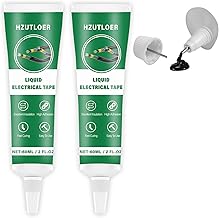
Haha- no, all the above is true as I got tired of the cans drying out too. I was about to try dropping them in a quart size canning jar, dribble some acetone or such in there too, then sealing it with the metal lids. But then I discovered the stuff in a squeeze tube. Seems to last much longer as each tube is 4oz and you don't break the seal on the second one until needed. It's on amazon so it's not american made but seems to be usefull.

61hgic3aG3L._AC_UY218_.jpg
 

LCA078

Senior Member
Joined
Sep 29, 2019
Messages
718
Location
Austin, TX
Ohh- and I forgot to mention, the best part of the squeeze tube version is you can apply a precise amount where needed instead globbing it on with the can supplied brush. Also eliminates most of the stringy hairs that you get from using the brush. Again, only been using these for a couple years but the stuff appears to be decent quality.
 

Mallard

Active Member
Joined
Oct 4, 2016
Messages
34
Location
Arkansas
Thanks for everyone help, I was able to get the plug apart and solder and heat shrink a new wire in. Then crimped and heat shrink the broken wires.

Now I have no error codes on the display and the machine will hit 2100 rpm in H/P mode.

Still can’t identify where my hydraulic leak or leaks are on the control valve. When I get that figured out it will be time to run it for a few hours and hopefully everything is fixed.

I think this fall I’ll replace the seat and reseal the joystick controls. Also think one of the joystick is bent as the left one is farther forward and has an angle to it. Wonder if someone fell on it getting out at some point or used it to pull themselves in the cab.
 

HarleyHappy

Senior Member
Joined
Sep 30, 2020
Messages
3,369
Location
So NH
Occupation
Welder/Mechanic
Haha- no, all the above is true as I got tired of the cans drying out too. I was about to try dropping them in a quart size canning jar, dribble some acetone or such in there too, then sealing it with the metal lids. But then I discovered the stuff in a squeeze tube. Seems to last much longer as each tube is 4oz and you don't break the seal on the second one until needed. It's on amazon so it's not american made but seems to be usefull.

61hgic3aG3L._AC_UY218_.jpg
Will be ordering some right now, thanks Z,
 

Old Doug

Senior Member
Joined
Oct 16, 2013
Messages
5,573
Location
Mo
I have done a lot of wiring repair, splicing or building from scratch in my close to 50 years of mechanic work. About every time i crimp,solder or mess with a wire end I wonder if there is a better way or I should have done it different . Were I work there are around 20 straight trucks. I am going to look next week but i dont think any 2 had there tail lights wired the same.
 

John C.

Senior Member
Joined
Jun 11, 2007
Messages
13,126
Location
Northwest
Occupation
Machinery & Equipment Appraiser
I did a series of video on electrical connections a couple of years ago now. I think you can pick up the series using the link below. My conclusion on troubleshooting and repairing electrical problems come down to what ever works for you. I don't think of any particular process of troubleshooting or repair as being right or wrong anymore. In my mind it works or it doesn't work.


Nige

Senior Member
Joined
Jun 22, 2011
Messages
38,491
Location
G..G..G..Granville.........!! Fetch your cloth.
For single wires try a Deutsch Jiffy Splice. Effectively a single-pin Deutsch connector they are waterproof and the nice thing about them is that they can be disconnected and reconnected ad infinitum without requiring tools. The only downside is that you need a Deutsch crimp tool in order to crimp a pin or socket on the wire.

 
Top