• Thank you for visiting HeavyEquipmentForums.com! Our objective is to provide industry professionals a place to gather to exchange questions, answers and ideas. We welcome you to register using the "Register" icon at the top of the page. We'd appreciate any help you can offer in spreading the word of our new site. The more members that join, the bigger resource for all to enjoy. Thank you!

Shop floor concrete

Columbo

Senior Member
Joined
Dec 31, 2021
Messages
681
Location
New Hampshire
I’m not really sure where to put this, but figured here was as good as any-

I’m going to try to have my shop/garage floor poured this year. 36x36 with compacted crushed stone, XPS foam and radiant heat tubing under the concrete.

My questions are, for shop use that will see mini excavators, CTL, tractors, etc on it, should I spec 4” reinforced concrete or 6” reinforced concrete?

Once cured, should I pay to have the floor epoxy coated? I like the look of epoxy floors and the ease of cleaning spills but I question the durability. Anyone have long term experience with a particular epoxy coating? Other option is a concrete sealant, which is often used around here due to the salt dripping off vehicles and damaging the concrete.

Any other suggestions or wish-I-would-haves for concrete floors are welcome. Thanks!
 

CM1995

Administrator
Joined
Jan 21, 2007
Messages
15,957
Location
Alabama
Occupation
Running what I brung and taking what I win
If it were mine I would do 6" stone and 6" concrete with #4 rebar on a 4x4 grid with 9 wire mesh on top. Reinforcement is cheap up front. Your slab is small so the cost to upsize is not a huge difference up front but pays off in the long run.

The rebar will take the deflections and the mesh will hold it together.

Here in AL we don't have to worry about salt so no comment on that topic.

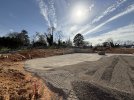
Just prep'd a HD concrete parking area for an amphitheater we are working on where the tour buses will be parking. Spec is 6" DGB base, #4 on a 2x2 grid and 6" of 4K concrete.

IMG_8589.jpeg
 

terex herder

Senior Member
Joined
Nov 10, 2017
Messages
2,310
Location
Kansas
I'd go with 6" of 4500 psi, 1/2" bar on 2' centers. Skip the wire, its never where it belongs. And spend the money on plenty of chairs for the rebar.

The 4500 psi isn't for the strength of the floor, but to make the floor strong enough that every little dropped piece of steel doesn't chip the floor. You need to talk to the concrete plants in your area. Concrete depends on local aggregate quality, if they have to truck in quality aggregate prices get even more stupid than they already are. Compromises may be necessary.

Every other portion of your building can be upgraded at some later time. But to upgrade the floor its easiest to build another building.

Don't skip the site prep. Concrete is nothing but a rug. A hard surfaced rug, but still a rug. The subgrade must be sufficient for the loading, and uniform in compaction.
 

materthegreater

Senior Member
Joined
Jul 25, 2012
Messages
2,074
Location
VT
For mine I did 1/2" rebar on 1' grid, I think 6" with 12" thickened edges (except the left side which is sitting directly on top of a block wall). I believe it is 3500 psi.

IMG_20181031_060248.jpg

I wish I'd gotten my act together to do it earlier in the year. It was Oct 31st and too cold to put a sealer on it. I ended up just using it and it got too dirty to seal so I just never did it. It has spalled where the salt drips off my plow truck... Other areas have held up fine.
 

mowingman

Senior Member
Joined
Jul 10, 2010
Messages
1,545
Location
North Central Texas
Occupation
Retired
Early in my career, long ago, I did ASTM Certified concrete testing on a regular basis. Go 6" with rebar as mentioned above. They will want to pour your floor very "wet", or high slump. That is bad for cracking and strength, but likely necessary with your heating tube system strung all through the floor. Therefore, I would go with 5000# test strength on the concrete, due to the high water content it will have. You really would like to have a 3"-4_" slump test, but in reality I bet you will get 6"-8".
 

CM1995

Administrator
Joined
Jan 21, 2007
Messages
15,957
Location
Alabama
Occupation
Running what I brung and taking what I win
You may want to consider having multiple 4 inch drains to be able to have whatever you wash down to drain out of shop.
And, You can not have to much light.

^This. Floor drains, forgot about floor drains.

I'd go with 6" of 4500 psi, 1/2" bar on 2' centers. Skip the wire, its never where it belongs. And spend the money on plenty of chairs for the rebar.

Wire mesh stays where it's needed if it's on top of the rebar that's on chairs. ;)
 

ianjoub

Senior Member
Joined
Jun 22, 2018
Messages
1,683
Location
Homosassa, FL USA
I did 3500# with fiber, 6" thick, no metal. I do not have large equipment on it though, only passenger cars and trucks.

I used Rust Oleum 2 part epoxy on my auto shop floor 15 years ago. It held up great. It wore away under the front of my primary lift from abrasion over time but never lifted, peeled, or had problems from heat or chemicals. I was quite pleased. I put the same down in my new shop and have no problems. The new shop gets light use and is only 4 or 5 years old though.

Yes on the light. I have 28 eight foot LED strips on the ceiling of my 36' x 84' shop with 14' walls. They are the 5k I believe (quite white vs. yellowish/soft color). They provide a lot of light but I still have more of the strips on the bottom side of some shelves over my bench tops. I am old and need lots of light.

I did 5 1/2 inches of spray foam and then put 3/4" R-Max foam board over the top of it. Two 3 ton mini splits keep it 68 degrees inside year round here in FL and use very little electric. I would guess $100/mo.

IMG_20201029_152159.jpg
 

Columbo

Senior Member
Joined
Dec 31, 2021
Messages
681
Location
New Hampshire
^This. Floor drains, forgot about floor drains.


Wire mesh stays where it's needed if it's on top of the rebar that's on chairs. ;)
Keep the suggestions coming, I really appreciate it.

Unfortunately, NH (where I live) regulates floor drains. Officially, they have to be piped through a grease trap and into an approved septic/stormwater management field. Unofficially…. Well, concrete them over before you sell the house. The workaround called out on my prints is to have the slab pitched towards each of the overhead doors….
 

Columbo

Senior Member
Joined
Dec 31, 2021
Messages
681
Location
New Hampshire
I did 3500# with fiber, 6" thick, no metal. I do not have large equipment on it though, only passenger cars and trucks.

I used Rust Oleum 2 part epoxy on my auto shop floor 15 years ago. It held up great. It wore away under the front of my primary lift from abrasion over time but never lifted, peeled, or had problems from heat or chemicals. I was quite pleased. I put the same down in my new shop and have no problems. The new shop gets light use and is only 4 or 5 years old though.

Yes on the light. I have 28 eight foot LED strips on the ceiling of my 36' x 84' shop with 14' walls. They are the 5k I believe (quite white vs. yellowish/soft color). They provide a lot of light but I still have more of the strips on the bottom side of some shelves over my bench tops. I am old and need lots of light.

I did 5 1/2 inches of spray foam and then put 3/4" R-Max foam board over the top of it. Two 3 ton mini splits keep it 68 degrees inside year round here in FL and use very little electric. I would guess $100/mo.

View attachment 336718
Ok, so this brings up a good question. I have 12.5’ ceilings in this garage/shop and I’ve thought about installing a car lift in the future. What prep should I include in the floor for that now? Strip footings below the floor and omit the XPS in those locations?
 

Tugger2

Senior Member
Joined
Mar 22, 2018
Messages
1,494
Location
British Columbia
Ive done 3 shop floors for myself over the years. 6" thick, #4 bar on a 12" grid has worked well for me. Ive never considered sealing as i do a lot of burning and welding. Ive got 10 years on my current shop .Theres a few divots in the floor ,but its a shop. Its stood well to every thing i do ,Had tracks from my mini excavator to crawler cranes and a D8 run on it.
The base is the key ,I know you have that part dialed.
 

CM1995

Administrator
Joined
Jan 21, 2007
Messages
15,957
Location
Alabama
Occupation
Running what I brung and taking what I win
Keep the suggestions coming, I really appreciate it.

Unfortunately, NH (where I live) regulates floor drains. Officially, they have to be piped through a grease trap and into an approved septic/stormwater management field. Unofficially…. Well, concrete them over before you sell the house. The workaround called out on my prints is to have the slab pitched towards each of the overhead doors….

That sucks on the floor drains.
 

CM1995

Administrator
Joined
Jan 21, 2007
Messages
15,957
Location
Alabama
Occupation
Running what I brung and taking what I win
It really does! Especially since a lot of snow/ice/slush comes in on the cars in the winter. My last house had a garage with the floor dead level. I’d be pushing water out of there with a floor broom after every snowstorm.

I can understand an oil/water separator for a commercial auto/tire/repair shop floor drain(s) but residential is a little overboard.
 

crane operator

Senior Member
Joined
Mar 27, 2009
Messages
10,148
Location
sw missouri
I don't care for floor drains myself. I don't want a tapered floor that runs to the drains, because its hard to build items on the floor. If the floor is level, its easy to build square items on it, if its tapered multiple directions, nothing you build is square when done.

Also, I don't want a oil/antifreeze fluid spill pouring into the floor drain. I want to clean it up where it is.

Its really hateful when that special bolt rolls right down between the grates of the drain. I used to do a lot of work in a shop that had a center drain.

As far as the lift goes, put footers where it may go. And make sure you know where the lines are, and give yourself plenty of space. Hammer drill in a anchor for the lift, and hit one of your in floor heat lines is going to make for a great day.
 

Georgia Iron

Senior Member
Joined
May 6, 2012
Messages
1,318
Location
USA - Georgia
Occupation
Concrete building slab and grading contractor
I did not really catch what this slab is for basic storage or a working shop. If it's a working shop here is some ideas

I have poured a lot of concrete and built a lot of slabs. I have seen and been around so many pours that went badly due to poor planning. I have seen entire pours 7" thick, 40,000 sq ft, crack due too improper retarder being used. I have also seen slab ruined because the base was not same through out the slab. Hard and soft areas can ruin the pour later.

I would consider where you need power at on the floor and run it under the Slab. I would consider my compressor location, lathe / mill locations and Welder locations for power and air piping.

I don't think gravel does much of anything if your base material is hard and compacted. Installing metal weld plates on the floor are a consideration for pushing and pulling operations. These can require a "pre pour".

Doing all the wire and rebar will require a pump either line or boom.

My favorite shop, i have seen had a 2 leveled pour. If you have some slopeing grounds to allow it. Basically you pour a retaining wall and a lower floor say on the back side of the shop. Then you have a few steel beams that you can drive onto that are main floor level, out onto the lower floor area. You can access under a truck or equipment from the lower level and also have a lower side roll up door for a lower side entry and another work bay down there. It was great for working on big rigs.. a poured set of stairs went to the lower level and they had a full set of tools and benches down there for engine and transmission work. Spilt floor designed work area. No pit needed

I have also seen steel runners in slabs for metal tracked equipment. Not sure what to tell you on the concrete specs, i have had conflicting things told to me and all the better pours are done at night. Too expensive for a basic pad. The concrete we are going to start a new large project with now requires a license to pour it. It is some crazy neat stuff.

On basic concrete one set of engineers made me use 3000 psi for slower cure time and less cracking. A good cool day with mist in the air is probably the best you could hope to pour on.

a lot of job site surface prep is done to allow construction to continue through wet site conditions. Gravel and soil cement being two things that can allow a jobsite to carry on faster through the wet times, when time is big money. I would never use gravel unless my dirt was poor. It all depends upon your soils and what you are building on.. a loaded dump truck doing a pre compaction test will answer your questions about your soil weight bearing capacity. A truck load of concrete is not too much terribly higher in cost than gravel so why would you put GAB down when the slab could be 10"s thick. A local cat yard here had double rebar with 12" thick isolated slabs for just the parking lot. 1.75 metal dowels tying sections together.

After pour, I would definitely green saw cut my 36 x 36 slab and put my cuts based on how my work areas laid out as equally as possible.

Getting your drainage right and grading right is just as important as the concrete keeping a dry base under the slab will pay for itself over and over
 
Last edited:
Top