• Thank you for visiting HeavyEquipmentForums.com! Our objective is to provide industry professionals a place to gather to exchange questions, answers and ideas. We welcome you to register using the "Register" icon at the top of the page. We'd appreciate any help you can offer in spreading the word of our new site. The more members that join, the bigger resource for all to enjoy. Thank you!

CAT 988H Lift and and Tilt linkage position sensors not calibrating

fmatemberere

Well-Known Member
Joined
Apr 1, 2016
Messages
70
Location
Australia
Occupation
Diesel Fitter
Please help, our 988 H loader has 2 active codes for lift and tilt linkage position sensors out of calibration. I am calibrating them and the ET is saying successfull but the active codes are not clearing and the machine is still having lift and tilt issues.If I disconnect the sensors the ET is reading the disconnection.The serial number is BXY01906
 

Nige

Senior Member
Joined
Jun 22, 2011
Messages
38,524
Location
G..G..G..Granville.........!! Fetch your cloth.
Do you have any other Active Codes on the machine apart from the FMI13 Codes for the Lift & the Tilt Position sensor.?

Refresh my memory. Is the procedure for calibrating the Lift sensor still a 5-step process as listed below: -
1. Raise the lift arm up the the kickout point and press OK.
2. Raise the lift arm up until the cylinders top out and press OK.
3. Tilt the bucket all the way backwards and press OK.
4. Lower the lift arm until the bucket touches the ground and press OK.
5. Lower the lift arm until the bucket cylinders bottom out (this will lift the front wheels off the ground) and press OK.

Before attempting another calibration use ET to check the minimum and maximum % values of the sensor signal for both Lift & Tilt. Post the results here.

A few things that you can check. Take off all the protective covers for the Lift & Tilt position sensors. Make sure that all the hardware securing the sensors is tight. Check for bent operating rods or levers. Check that the pins/bolts that push the lever attached to the sensor shaft and rotate the sensor are tight and straight. Despite the robust guards I've seen all sorts of messes behind them before that nobody knew anything about until the guards were removed.
 

fmatemberere

Well-Known Member
Joined
Apr 1, 2016
Messages
70
Location
Australia
Occupation
Diesel Fitter
The Lift and Tilt position sensors are the only active codes at the moment. The procedure to calibrate Themis as below:

- Turn the ignition key on and don’t start
-Apply park brake and press next
-Lock the implement switch and press next
- Make sure the Lift lever is in neutral and press next
-Pull Lift lever to full raise and press next
-Push the Lift lever to lower down and press next

-Repeat the same for the Tilt lever.
 

Nige

Senior Member
Joined
Jun 22, 2011
Messages
38,524
Location
G..G..G..Granville.........!! Fetch your cloth.
Please help, our 988 H loader has 2 active codes for lift and tilt linkage position sensors out of calibration. I am calibrating them and the ET is saying successfull but the active codes are not clearing and the machine is still having lift and tilt issues.If I disconnect the sensors the ET is reading the disconnection.The serial number is BXY01906
Your OP specifically refers to the "linkage position sensors".
The Lift and Tilt position sensors are the only active codes at the moment. The procedure to calibrate Themis as below:

- Turn the ignition key on and don’t start
-Apply park brake and press next
-Lock the implement switch and press next
- Make sure the Lift lever is in neutral and press next
-Pull Lift lever to full raise and press next
-Push the Lift lever to lower down and press next

-Repeat the same for the Tilt lever.
That is the procedure to calibrate the position sensors for the lift & tilt CONTROL LEVERS in the cab. Not the same thing ..........

What are the Diagnostic Code Numbers that you have active.? I'll lay a bet that they are 0350 & 0351.
 

fmatemberere

Well-Known Member
Joined
Apr 1, 2016
Messages
70
Location
Australia
Occupation
Diesel Fitter
Yes Nige , the fault codes are 350-13 and 351-13.
Is there a different procedure to calibrate these please?
 

Nige

Senior Member
Joined
Jun 22, 2011
Messages
38,524
Location
G..G..G..Granville.........!! Fetch your cloth.
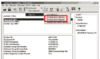
Yes indeedy there is......... go into the Calibrations menu in ET and select "Lift Linkage Sensor Calibration". It's directly below the "Lever Calibrations" option.
After you have done that calibration you'll need to go back into the menu again and this time select "Tilt Linkage Sensor Calibration". See below - the 2nd illustration is what the calibration sequence for the Lift linkage sensor should look like. Pay special attention to the fact that when you do the 3rd step of the procedure that calls to bottom out the lift cylinders you will lift the front wheels off the ground.
upload_2021-4-15_22-24-3.png
upload_2021-4-15_22-25-8.png

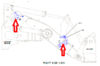
Just to explain for anyone who may be confused, the Lift/Tilt LINKAGE position sensors are these two. They measure the movement of the front linkage....
upload_2021-4-15_22-28-28.png
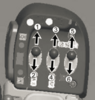
The Lift/Tilt LEVER position sensors are located under the RH armrest directly under the levers. Unsurprisingly, they measure the movement of the control levers.
upload_2021-4-15_22-30-18.png
 

fmatemberere

Well-Known Member
Joined
Apr 1, 2016
Messages
70
Location
Australia
Occupation
Diesel Fitter
Thank you Nige, I followed what you said and I managed to calibrate the linkage position sensors and cleared the faults. They used the machine for a bit but they are saying the hydraulics are slow. I didn’t get the chance to check if the sensors are out of calibration again or not. I will check on Monday and post here. Thank you.
 

Nige

Senior Member
Joined
Jun 22, 2011
Messages
38,524
Location
G..G..G..Granville.........!! Fetch your cloth.
I don't think the FMI13 Codes would come back unless someone disconnected a wiring harness to those two sensors or something similar. I also don't think FMI13 Codes would cause slow hydraulic system response. The only thing I know of that would not work is that the Lift & Tilt Kickouts would stop working - obvious really if the sensors don't know where the lift arm or the bucket is.

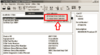
After checking if the FMI13s have come back (I suspect they will not have) I would suggest to calibrate the Implement Valve solenoids. That's the button right at the bottom of the calibrations menu indicated by the arrow. NOTE: You will need the oil at normal operating temperature to make the calibrations so you need to make sure that the machine is fully warmed up before attempting to do the calibrations.

upload_2021-4-16_16-42-59.png
 

fmatemberere

Well-Known Member
Joined
Apr 1, 2016
Messages
70
Location
Australia
Occupation
Diesel Fitter
Sorry Nige for taking too long to reply, the loader with creeping Lift cylinders was a 980H and the Cat dealer is working on it at the moment. This one has s a 988H. I managed to calibrate all sensors , lift and tilt levers and implement solenoids. The fault are clearing but after a few hours of work thee Tilt linkage position sensor is getting out of calibration again. I just noticed that the Tilt Stops are worn, can this cause the sensor to get out of calibration because of too much bucket tilt?
Also the Auto bucket crowding is not working.We have just fitted new sensors but the Tilt is still going out of calibration
 

Nige

Senior Member
Joined
Jun 22, 2011
Messages
38,524
Location
G..G..G..Granville.........!! Fetch your cloth.
The fault are clearing but after a few hours of work thee Tilt linkage position sensor is getting out of calibration again. I just noticed that the Tilt Stops are worn, can this cause the sensor to get out of calibration because of too much bucket tilt?
That might be possible, however I would've thought wear (or something loose) in the sensor operating linkage (or even the pins/bushes in the bucket tilt linkage) would be a more likely cause.
Also the Auto bucket crowding is not working. We have just fitted new sensors but the Tilt is still going out of calibration
If you have ANY Code for the tilt linkage sensor the Tilt Kickout will not work because it depends on a signal from the same sensor.

If I can explain it this way, when you do the calibration the ECM records the minimum & maximum values of the sensor, whatever those values might be. Let's say for example they are 14% min & 87% max. When the machine is working so long as the values registered by the ECM do not go outside that range while the linkage is moving - no problem. If one does (and I don't know by how much the signal has to go outside the calibration range) then the ECM should register an FMI13 Code.

Can you investigate exactly when it is losing the calibration.?
For example does it lose it after the key has been switched off for a while.? Say lunch break, shift change, parked overnight.?
Or does it lose calibration while the machine is operating.?
 

fmatemberere

Well-Known Member
Joined
Apr 1, 2016
Messages
70
Location
Australia
Occupation
Diesel Fitter
The sensor is losing calibration when the machine is operating especially when it bangs when tilting. It happened to me me when I just did the calibration and I was testing it. My operation was not smooth and I banged it tilting back and it got out of calibration.
 

Nige

Senior Member
Joined
Jun 22, 2011
Messages
38,524
Location
G..G..G..Granville.........!! Fetch your cloth.
OK, so that rules out anything ECM-related IMO. I was just wondering if it was losing calibration when it was powered off.

It may be the bucket stops but think about what i said regarding the calibration. The ECM stores the minimum & maximum values registered by the sensor during the calibration process - from the rackback stop to the dump stop - whatever those values might be.

I still think the chances are that the loss of calibration is a result of wear in the linkage pins/bushes. I'd suggest to take a good look at the 4 pins joints that I have circled on the illustration below. You may need some sort of lifting device to give the linkage a bit of a rattle around and check for movement. If the pins/bushes are in good condition there should be next to no visible movement in any of those four joints.

I will look to see if there is anything regarding rebuilding the stops on both the boom and the tilt levers and post back. If they do get built up and it's not done correctly there is a significant risk of a broken boom. Don't ask me how I know that.........

upload_2021-4-24_15-52-25.png
 

Nige

Senior Member
Joined
Jun 22, 2011
Messages
38,524
Location
G..G..G..Granville.........!! Fetch your cloth.
Here's a question for you. Does your machine have the modified dump stops on the back side of the bucket.?
Reason I ask is that they only came on the scene after BXY01906 was built. Now if it has had a new bucket at some time then that bucket may well have been built with them.

upload_2021-4-24_16-14-53.png
 

kshansen

Senior Member
Joined
Mar 11, 2012
Messages
11,407
Location
Central New York, USA
Occupation
Retired Mechanic in Stone Quarry
Probably not anything to do with this problem but the 988H at the quarry had a rock fall over the top of the bucket and literally knock the tilt sensor off the boom. Only real damage was three broken bolts. But after removing the broke bits of the bolts bucket would not work.

I believe what the cause was that the linkage for the sensor had stoked it well past the normal position. At that time we did not have Cat ET so they called the dealer to come out and work on it. Boss was a bit ticked off that it took the mechanic longer to read through the quarries required safety booklet than to get the machine working again via calibration!
 

Olori Joshua

Well-Known Member
Joined
Mar 5, 2020
Messages
120
Location
Abuja, Nigeria
Occupation
Heavy equipment technician
Here's a question for you. Does your machine have the modified dump stops on the back side of the bucket.?
Reason I ask is that they only came on the scene after BXY01906 was built. Now if it has had a new bucket at some time then that bucket may well have been built with them.

View attachment 237868
I am here in 2025 commenting on a 2021 post. This forum will even be more helpful in the future. Thanks our senior member Mr. Nige. I have observed that you are always ready to give an answer.

Please I have some questions concerning Caterpillar wheel loaders that have electrohydraulic system.

1. I have a 966H with prefix A6G showing tilt linkage position sensor out of calibration with 351-13 active fault code but the machine is tilting fine. why is it tilting fine with the fault code?

2. Can one successfully carry out implement control valves calibration on a 980H that has the lift and tilt linkage position sensors bad?

3. What is the function of the lift and tilt linkage position sensors to calibrating the implement control valves?

4. Please explain "a & b" below to me. I have pause a tilt linkage calibration that is out of calibration because I did not understand those two steps very well. I understood the other three steps out of the five Calibration steps.
a. slowly lower the linkage to the minimum position and bottom out the lift cylinders.
b. slowly raise the linkage to the maximum position.

I will be grateful for your response to my request. Thank you already.

 

Nige

Senior Member
Joined
Jun 22, 2011
Messages
38,524
Location
G..G..G..Granville.........!! Fetch your cloth.
I have a 966H with prefix A6G showing tilt linkage position sensor out of calibration with 351-13 active fault code but the machine is tilting fine. why is it tilting fine with the fault code?
The tilt hydraulics will still work. The position sensor feeds a signal into the ECM and one of the functions of that signal is to indicate when the tilt cylinder is close to the end of its stroke. The ECM commands the implement control valve to close down slightly (known as snubbing) to lessen the end-of-stroke impact. If the position sensor is not calibrated tilt will still work but you will have no snubbing.
Can one successfully carry out implement control valves calibration on a 980H that has the lift and tilt linkage position sensors bad?
No. The reason for this is that the first commands in the calibration process instruct you to set the lift position sensor between two certain limits and then do the same with the tilt position sensor. If neither of those two sensors are not giving a signal the calibration cannot proceed.
a. slowly lower the linkage to the minimum position and bottom out the lift cylinders.
b. slowly raise the linkage to the maximum position.
a. The first instruction is telling you to lower the bucket slowly until it touches the ground. Then once you have done that you need to use the power down function on the lift control lever to completely close (bottom out) the lift cylinders. The second part of this step may raise the front wheels of the loader slightly off the ground.

b. IIRC this step used to be in two parts. "Raise the linkage to the kickout and press OK", then "Extend lift cylinders completely and press OK". I used to slowly raise the lift cylinders to full extension then lower them about 1" which would be the kickout point, press OK, then raise the cylinders fully. and press OK a second time. Again what this is doing is to set the point at which the ECM commands the snubbing to operate in order to avoid high speed impacts in the cylinder.

If you have only one step "slowly raise the linkage to the maximum position" then do exactly that. Slowly raise the lift cylinders to full extension, let go of the lift control when the cylinders stop moving, and hit "OK" or "Next", whichever is appropriate.
 

Olori Joshua

Well-Known Member
Joined
Mar 5, 2020
Messages
120
Location
Abuja, Nigeria
Occupation
Heavy equipment technician
The tilt hydraulics will still work. The position sensor feeds a signal into the ECM and one of the functions of that signal is to indicate when the tilt cylinder is close to the end of its stroke. The ECM commands the implement control valve to close down slightly (known as snubbing) to lessen the end-of-stroke impact. If the position sensor is not calibrated tilt will still work but you will have no snubbing.

No. The reason for this is that the first commands in the calibration process instruct you to set the lift position sensor between two certain limits and then do the same with the tilt position sensor. If neither of those two sensors are not giving a signal the calibration cannot proceed.

a. The first instruction is telling you to lower the bucket slowly until it touches the ground. Then once you have done that you need to use the power down function on the lift control lever to completely close (bottom out) the lift cylinders. The second part of this step may raise the front wheels of the loader slightly off the ground.

b. IIRC this step used to be in two parts. "Raise the linkage to the kickout and press OK", then "Extend lift cylinders completely and press OK". I used to slowly raise the lift cylinders to full extension then lower them about 1" which would be the kickout point, press OK, then raise the cylinders fully. and press OK a second time. Again what this is doing is to set the point at which the ECM commands the snubbing to operate in order to avoid high speed impacts in the cylinder.

If you have only one step "slowly raise the linkage to the maximum position" then do exactly that. Slowly raise the lift cylinders to full extension, let go of the lift control when the cylinders stop moving, and hit "OK" or "Next", whichever is appropriate.
Many thanks for your answers. The points are very clear to me now expecially the snubbing effect ( to lessen the end of stroke effect)

b. IIRC this step used to be in two parts. "Raise the linkage to the kickout and press OK", then "Extend lift cylinders completely and press OK". I used to slowly raise the lift cylinders to full extension then lower them about 1" which would be the kickout point, press OK, then raise the cylinders fully. and press OK a second time. Again what this is doing is to set the point at which the ECM commands the snubbing to operate in order to avoid high speed impacts in the cylinder.

If you have only one step "slowly raise the linkage to the maximum position" then do exactly that. Slowly raise the lift cylinders to full extension, let go of the lift control when the cylinders stop moving, and hit "OK" or "Next", whichever is appropriate.
Please another clarification needed. In setting the sensor linkage to minimum and maximum positions for calibration, do I need not to first connect the sensor to the linkage plate on the tilt arm as pointed on the attached picture and use my hand to set the minimum and maximum of the rotary sensor before connecting it to the linkage plate?

Or how do I set the minimum and maximum positions? Let's say with a new sensor that has not been connected?

Thank you.


20250415_083810.jpg
 

Nige

Senior Member
Joined
Jun 22, 2011
Messages
38,524
Location
G..G..G..Granville.........!! Fetch your cloth.
Or how do I set the minimum and maximum positions?
If you are trying to fool the ECM in order to do a calibration - good luck. You just have to mess with the sensor until it is in the required signal range as measured with ET.

If you are talking about installing a new sensor then as far as I am aware you cannot install it incorrectly.
1. Install the sensor. The bolt pattern is not symetrical so the sensor can only be installed in one specific orientation.
2. The sensor shaft has a flat on it that will only permit the short "arm" #8 and the clamp #5 to be installed over that shaft in one specific position.
3. You then rotate the short arm/sensor combination so that the spacer on the end of the long arm can be installed in the slot in the short arm. Install the two bolts that fix the long arm to the tilt lever and that's it.

By the way you really need to fix the oil leak that is contaminating the sensor. Both the sensor and its harness will not react well to the presence of hydrocarbons.

1744854657617.png

Question: Is the large arm bent around where your blue arrow is.? It's supposed to look like this illustration.

1744855748914.jpeg
 

Olori Joshua

Well-Known Member
Joined
Mar 5, 2020
Messages
120
Location
Abuja, Nigeria
Occupation
Heavy equipment technician
If you are trying to fool the ECM in order to do a calibration - good luck
No messing with the sensor LOL. It is my first time carrying out this calibration that is why the many questions for clarification. I do not know how to do what am not sure of.
If you are talking about installing a new sensor then as far as I am aware you cannot install it incorrectly.
1. Install the sensor. The bolt pattern is not symetrical so the sensor can only be installed in one specific orientation.
2. The sensor shaft has a flat on it that will only permit the short "arm" #8 and the clamp #5 to be installed over that shaft in one specific position.
3. You then rotate the short arm/sensor combination so that the spacer on the end of the long arm can be installed in the slot in the short arm. Install the two bolts that fix the long arm to the tilt lever and that's it.
Thank you. I will do just that today and hopefully I got it calibrated successfully.
By the way you really need to fix the oil leak that is contaminating the sensor. Both the sensor and its harness will not react well to the presence of hydrocarbons.
There was no oil leakage. We oiled the bolts to be able to loosen them. They have so rust and will break out if one apply more torque.
Question: Is the large arm bent around where your blue arrow is.? It's supposed to look like this illustration.

The arm is not bent, I think it looks like that because of the angle I took the picture from.
 
Top