
• Thank you for visiting HeavyEquipmentForums.com! Our objective is to provide industry professionals a place to gather to exchange questions, answers and ideas. We welcome you to register using the "Register" icon at the top of the page. We'd appreciate any help you can offer in spreading the word of our new site. The more members that join, the bigger resource for all to enjoy. Thank you!

480e hydraulics

HarleyHappy

Senior Member
Joined
Sep 30, 2020
Messages
3,438
Location
So NH
Occupation
Welder/Mechanic
My 580 SE has a filter light on the dash, that actually still works.
Why don’t you use the throttle stick to bring the RPMS into the suspect area and safely go underneath and also check every available surface for excessive heat build up.
That may indicate where the problem lies.
I‘m thinking pump, oil cooler lines, all cylinders and supply and return from filter along with filter housing.
 

kyaabo

Active Member
Joined
Apr 12, 2026
Messages
31
Location
NY
My 580 SE has a filter light on the dash, that actually still works.
Why don’t you use the throttle stick to bring the RPMS into the suspect area and safely go underneath and also check every available surface for excessive heat build up.
That may indicate where the problem lies.
I‘m thinking pump, oil cooler lines, all cylinders and supply and return from filter along with filter housing.
Filter light does work, tested the sensor and wiring so no light on dash means filter is not in bypass?
 

kyaabo

Active Member
Joined
Apr 12, 2026
Messages
31
Location
NY
My 580 SE has a filter light on the dash, that actually still works.
Why don’t you use the throttle stick to bring the RPMS into the suspect area and safely go underneath and also check every available surface for excessive heat build up.
That may indicate where the problem lies.
I‘m thinking pump, oil cooler lines, all cylinders and supply and return from filter along with filter housing.
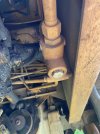
Just climbed under the backhoe with the rpms at 1500, this hydraulic block seems to be making the noise and vibrating… is there anything I can take apart and clean/check? I think it’s the flow control valve according to the manual? Thanks a ton for your help figuring this out.
 

Attachments

  • IMG_1856.jpeg
    IMG_1856.jpeg
    1.7 MB · Views: 8
  • image.jpg
    image.jpg
    2.1 MB · Views: 8
Last edited:

kyaabo

Active Member
Joined
Apr 12, 2026
Messages
31
Location
NY
power steering lines at the cylinders wee loose, tightened and no change in the noise.

Removed the main pressure relief valve and it is clean as can be.

Removed main flow control valve and is also clean as can be.

Hydraulic dipstick shows full, when I extend all hydraulic cylinders there is nothing on the dipstick. I realize the cylinders use oil from the reservoir but is this normal even though you check the fluid with all cylinders retracted correct?

Also there was pressure/vacuum when I removed the dipstick after shutting of the engine with the loader extended in the air.

I then lowered the loader to the ground with the engine still off… when I removed the hydraulic dipstick there was pressure like a gunshot air escaping. This can’t be right…. It there a hydraulic tank vent or relief that could be clogged?
 
Last edited:

HarleyHappy

Senior Member
Joined
Sep 30, 2020
Messages
3,438
Location
So NH
Occupation
Welder/Mechanic
Depending on your year, some tanks had a breather on them but I have only heard of them. Generally there is positive pressure on the hydraulics, to help feed the pump. Wat your describing does not seem right. If there is that much pressure returning to the tank from just lowering the front bucket, that sounds wrong. On mine, I can do the same thing, and you can hear the fluid rushing back to the tank but not with any power.
Do you have th manual for the machine?
I am very familiar with hydraulic flow controllers and have no idea why you would have one on a backhoe.
 

kyaabo

Active Member
Joined
Apr 12, 2026
Messages
31
Location
NY
Depending on your year, some tanks had a breather on them but I have only heard of them. Generally there is positive pressure on the hydraulics, to help feed the pump. Wat your describing does not seem right. If there is that much pressure returning to the tank from just lowering the front bucket, that sounds wrong. On mine, I can do the same thing, and you can hear the fluid rushing back to the tank but not with any power.
Do you have th manual for the machine?
I am very familiar with hydraulic flow controllers and have no idea why you would have one on a backhoe.

I have the full manual. The hydraulic schematic shows the breather on the tank as well as the flow control valve, could not located the breather without taking off any panels. I did take the dipstick out of the tank and started the machine effectively venting the tank… same noise at 1500 rpm.

The flow control valve is plumbed from the supply side of the pump, then a line to the hydraulic block for the bucket, and two lines for the power steering. I did not follow how it is plumbed to the backhoe controls. Also the pump pulls from the bottom of the hydraulic tank and the filter housing is on the return to the tank after all hydraulic circuits entering the tank about 8” from the bottom.

What I did notice is the dipstick is “stepped” with 2 90 tabs so you have to spin the dipstick to remove, are those tabs for checking fluid “cold vs hot”? The manual says nothing about what they are there for. If it was low on fluid I would think the controls would be jumpy though.

It’s very odd as the backhoe works perfectly just that noise with any rpm off of idle. At idle the backhoe controls work without that noise.

It’ll be 2 weeks before I get a chance to look at it again at the cabin.
 

MG84

Senior Member
Joined
Jan 6, 2023
Messages
1,397
Location
Virginia
The hydraulic tank on a 480E should always have positive pressure under normal operation, if you remove the cap when running or after running and there is no pressure in the tank you have a problem. It's pressurized to keep a constant feed of oil to the pump and keep contaminates out. Be sure to always snug the cap down to make it seal. The two metal tabs that you have to turn 90* each way when removing the dipstick are a safety. Otherwise someone may quickly unscrew the dipstick and have it blow out in their face due to the pressure in the tank. There is a pretty big OK range on the dipstick to cover temperature and such. With the machine cold, buckets down, outriggers up, it should be somewhere in the middle of the hatch marks. There is A LOT of oil in the tank below where the dipstick reaches, with all cylinders extended it may not read on the stick, but there are still many gallons in the tank. You said you have a shop manual, do you have an owners manual? All of this is covered in the owners manual, not the shop manual.

Is there anyone near by with heavy equipment experience? Sometimes having a second set of ears listen to it can be helpful. What you are hearing 'could' be normal, it can be hard to diagnose sound like that over the internet.
 

kyaabo

Active Member
Joined
Apr 12, 2026
Messages
31
Location
NY
The hydraulic tank on a 480E should always have positive pressure under normal operation, if you remove the cap when running or after running and there is no pressure in the tank you have a problem. It's pressurized to keep a constant feed of oil to the pump and keep contaminates out. Be sure to always snug the cap down to make it seal. The two metal tabs that you have to turn 90* each way when removing the dipstick are a safety. Otherwise someone may quickly unscrew the dipstick and have it blow out in their face due to the pressure in the tank. There is a pretty big OK range on the dipstick to cover temperature and such. With the machine cold, buckets down, outriggers up, it should be somewhere in the middle of the hatch marks. There is A LOT of oil in the tank below where the dipstick reaches, with all cylinders extended it may not read on the stick, but there are still many gallons in the tank. You said you have a shop manual, do you have an owners manual? All of this is covered in the owners manual, not the shop manual.

Is there anyone near by with heavy equipment experience? Sometimes having a second set of ears listen to it can be helpful. What you are hearing 'could' be normal, it can be hard to diagnose sound like that over the internet.
Thank you for the information, very helpful as far as the tank pressure. I do have both the service manual and owners manual.

Can I ask how the tank builds pressure during operation?

Cabin is very rural and nobody really around, I could ask one of the local farmers I guess.

The noise is ear piercing to where you have to wear ear plugs if running the machine for a couple hours straight.

I am going to attempt to access the pump, but that involves removing the heavy counterweight on the front of the machine and I don’t know how I would remove/install that safely.

Next time I’m up there I could do another video of a walk around at 1500 rpm and exercise the controls to see if that helps diagnose.
 

HarleyHappy

Senior Member
Joined
Sep 30, 2020
Messages
3,438
Location
So NH
Occupation
Welder/Mechanic
I took the risk and cut those tabs off on my dipstick, as trying to get it in to check the tank level was very hard to get those tabs to line up was frustrating.
I also sanded my dipstick a bit and painted it flat black, to help me see the level, as in sunlight, I could never see it.
Sounds like your breather is plugged.
On m machine, I just raise the loader up, set the support and take off the 2 top bolts on the grill and a couple on each side.
Take the air breather off and with the side panels off just lift up and slide to the front. You can turn it around the muffler a bit.
The top panel on the front, just lifts up and pulls away.
 

MG84

Senior Member
Joined
Jan 6, 2023
Messages
1,397
Location
Virginia
Can I ask how the tank builds pressure during operation?


The noise is ear piercing to where you have to wear ear plugs if running the machine for a couple hours straight.
Tank builds pressure through heat in the fluid, as the oil expands it pressurizes the system.

I just watched the video you posted, I can't tell how loud it is but the sound itself doesn't sound that odd. Could just be a weird harmonic/vibration at a certain rpm, I would also keep checking for loose things under/in the machine, sheet metal vibrating, etc. You could have something mechanical/hydraulic wrong or it may all be fine, again, hard to tell over the internet.

The 3.9 Cummins are not very smooth in those middle rpms, that's just the nature of 4 cylinder. My 1845C, 480E and 450C (all same 3.9 Cummins) have very definite vibration just above idle, by about 2/3 throttle it smooths out completely.

If it were me and I couldn't find anything definite wrong, I would:
1. Change fluid and filter on the hydraulics
2. Run and work the machine, keep and eye on hydraulic temperature and for signs of oil aeration
3. After a few days work cut the hyd filter open and see if there's any thing it in.
4. If all is well just run it and don't worry about it.
 

AU.CASE

Well-Known Member
Joined
May 7, 2010
Messages
239
Location
NSW Australia
Occupation
Grazier // Rancher remote NSW
Tank builds pressure through heat in the fluid, as the oil expands it pressurizes the system.

If it were me and I couldn't find anything definite wrong, I would:
1. Change fluid and filter on the hydraulics
2. Run and work the machine, keep and eye on hydraulic temperature and for signs of oil aeration
3. After a few days work cut the hyd filter open and see if there's any thing it in.
4. If all is well just run it and don't worry about it.
Great advice and my experience is from a different model, there is similar gear noise from the front mounted hydraulic pump.

Another difference is the tank level, there is no bayonet fitting dipstick, instead on the right hand side chassis tower [between the lift cylinder shaft and main pivot for the front hoist] a "sight eye" glass window (#7) shows the oil level, either in air [low] or full with no air visible.


1780442287942.png
 
Last edited:

kyaabo

Active Member
Joined
Apr 12, 2026
Messages
31
Location
NY
Tank builds pressure through heat in the fluid, as the oil expands it pressurizes the system.

I just watched the video you posted, I can't tell how loud it is but the sound itself doesn't sound that odd. Could just be a weird harmonic/vibration at a certain rpm, I would also keep checking for loose things under/in the machine, sheet metal vibrating, etc. You could have something mechanical/hydraulic wrong or it may all be fine, again, hard to tell over the internet.

The 3.9 Cummins are not very smooth in those middle rpms, that's just the nature of 4 cylinder. My 1845C, 480E and 450C (all same 3.9 Cummins) have very definite vibration just above idle, by about 2/3 throttle it smooths out completely.

If it were me and I couldn't find anything definite wrong, I would:
1. Change fluid and filter on the hydraulics
2. Run and work the machine, keep and eye on hydraulic temperature and for signs of oil aeration
3. After a few days work cut the hyd filter open and see if there's any thing it in.
4. If all is well just run it and don't worry about it.
so when the machine was cold, I started it up and raised the loader with the dipstick removed. I then turned the engine off, screwed the dipstick back into place and dropped the loader to the ground. There was enough pressure in the hydraulic tank that it sounded like a gunshot when I unscrewed the dipstick i’d estimate at least 20psi letting loose out the cap.

Can’t be normal right with a cold machine?
 

MG84

Senior Member
Joined
Jan 6, 2023
Messages
1,397
Location
Virginia
so when the machine was cold, I started it up and raised the loader with the dipstick removed. I then turned the engine off, screwed the dipstick back into place and dropped the loader to the ground. There was enough pressure in the hydraulic tank that it sounded like a gunshot when I unscrewed the dipstick i’d estimate at least 20psi letting loose out the cap.

Can’t be normal right with a cold machine?
Check items #5-8 in this diagram:


kyaabo

Active Member
Joined
Apr 12, 2026
Messages
31
Location
NY
Check items #5-8 in this diagram:

Will do, heading up this weekend to the cabin. I believe those items are under the bolted hood panel as I didn't see anything like that with the side panels removed.
 

kyaabo

Active Member
Joined
Apr 12, 2026
Messages
31
Location
NY
removed both relief valves, neither are working properly. No airflow out of the outlet or into the inlet relief valves. Also the filter is clogged on the inlet relieve valve. Going to order new parts and go from there.

Also how do you grease the pump coupler? It had a zerk in the diagram but I have no idea how to access it without removing the front counter weight which is 700lbs.
 

Tinkerer

Senior Member
Joined
May 21, 2009
Messages
10,164
Location
usa
Time to buy or borrow a transmission jack to handle the counterweight. It is the only safe thing to do it with.
Do not use plain ole gun grease.
A moly grease is what Case specifies.
 

HarleyHappy

Senior Member
Joined
Sep 30, 2020
Messages
3,438
Location
So NH
Occupation
Welder/Mechanic
Huh I was able to get in there from the side panel on my 580 SE with a 12” extender on one of my grease guns.
 

kyaabo

Active Member
Joined
Apr 12, 2026
Messages
31
Location
NY
Time to buy or borrow a transmission jack to handle the counterweight. It is the only safe thing to do it with.
Do not use plain ole gun grease.
A moly grease is what Case specifies.
yes i've been using moly on every fitting
 
Top